


By Mabinty M. Kamara
There is a construction boom going on in Sierra Leone, with hundreds of construction sites springing up in the capital and other cities across the country. This boom comes with high demand for raw materials like granite.
This demand has not translated to prosperity for most of those who work hard to meet that demand, according to artisanal stone miners in Gbangbayela, Moiba, Bathurst and Mende Quarry, communities based in the extreme end of the capital as they explained their challenges in the trade. This concern is not just unique to their area; low pricing is part of the daily grind of this job.
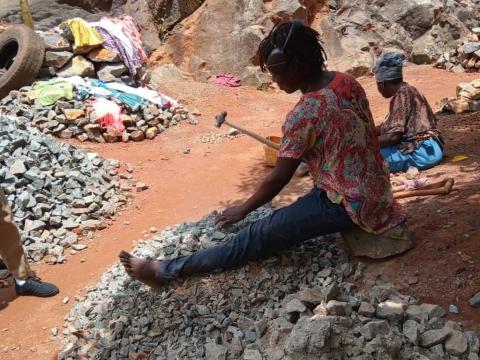
Artisanal stone mining is one of the most common trades in the informal sector. Stone crushers dig up stones using bars and pick axes. They then crush them into big chunks and later into smaller pieces, using different construction-size hammers. The final product is now sold to be used in concrete formula for construction.
Most stone crushers have been pushed to settle for this job as a source of income, because of the shortage of opportunities. Kadiatu Brima (35), moved from Bo in the south, five years ago, to search for better opportunities in the capital. She resorted to stone mining as her source of income.
From mining the stones to crushing and stacking them up in piles for sale, Kadiatu said it is a difficult process that cannot be done by a single person. Therefore, they team up and divide the labour and proceeds.
“Sometimes we buy the piles of granite stones from men who have mined them, and we then crush these portions into smaller sizes and pile them up for sale. I sometimes hire help, especially when a customer demands a huge quantity of the granite that should be delivered within a short period,” she said.
Ekinmba Koroma is one of those at the other end of the stone crushing business. Koroma (42) does the heavy lifting, by pulling the stone from the ground; burning, cracking and digging big boulders. He mines the stones and crushes them into large portions, acting as a wholesaler for people like Kadiatu.
“The pain is more than the gain, but as long as it keeps us alive that is the most important thing. Lifting this hammer and pickaxe every day is not easy. It exposes us to pain, injury and even hernia but it is better than to be a thief,” he smiled while looking at his coarse palm.
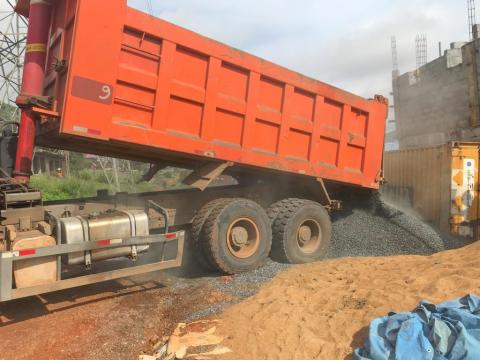
When Kadiatu is finally ready to sell her stone, it is measured in a head load contained in a bowl. One such head load sells for Le15 ($0.60) at the highest price. Kadiatu added that a greater part of the money sometimes goes to the drivers who normally buy from them and who in turn sell the truck full of granite to builders at construction sites, a process that leaves them with small money in return, which is barely enough for just their daily survival. “You will go to the market today and get pepper at Le 5, the next morning it can be Le10 or more,”
For Kadiatu, rent is not a challenge as her partner serves as a caretaker for a land on which there’s a little corrugated iron sheet structure (pan bodi) they currently occupy, yet survival has been difficult.
Issa Bangura (42) a stone crusher at Bathurst village in the outskirts of Freetown, says crushing stone is part of his everyday life. He has recruited his wife to support him with stone crushing. Bangura said, this is what “sustains the family”.
Bangura said, with a team of four including him they can crush 100 head loads in two weeks. Currently they are working towards a big sale, but the demand and the labor will be intense for the next few months.
“We currently have a contract for one thousand head loads of stone which is what we are working on. It all depends on how hard you’re able to work,” he said.
If they manage to meet their one thousand head pan demand, they could make as much as Le15, 000 ($632).
10 minutes’ drive away from Bathurst village, in the posh suburban Hill Station neighborhood, is Gbangbayela, a huge community. With fabulous houses springing up every day. The high rate of construction in the area has created a good demand for stones.
Saffie Kamara (40) a single mother of three has tapped into that opportunity - she is a stone crusher. Stone crushing is her only means of survival. With help from her teenage son Alimamy, she goes every day to work, crushing as much stone as she could.
Stone crushing comes with safety risks such as permanent eye injury and other parts of the body, something Saffie has suffered.
‘’I am doing all of this for my children so that they will not suffer as I am now, but it has not been easy raising them alone,”
She added: “I recently sustained an injury from a flying stone fragment. But if I decide to sit at home and recover, it would be a disaster. So, I have to come here and either hire help or get my son to help before he leaves for work,” she said.
Alimamy had to give up hope of going to college after writing his school leaving exams. Saffie said she could not afford to send him to college; hence he enrolled him to learn aluminum fabrication at a local workshop.
For women like Saffie and Kadiatu, despite the little benefit they get, there is dignity in their labor. Sometimes, women like these often fall prey to high interest micro-credit loans as an alternative.
“In fact, I was forced to leave my home town for the city because I could not repay a loan I took from a micro-credit organization. I had to pay them when I came here, out of the little I made from the stone crushing,” Kadie said.
There is no government regulation protecting people like Saffie, Kadiatu or other stone crushers in the city. With construction companies gradually springing up, ready to invest in heavy machinery, the livelihood of these stoner crushers could be in danger.
A worker at a quarry owned by a foreign construction company who prefers anonymity, admitted that stone mining and crushing is a profitable venture, especially for those with the equipment.
“Because we lack the required machinery and finance, it is difficult for our brothers and sisters to realize anything out of their labour. How many piles of stones can one crush in a day using manual labour, but a crusher can produce 26 or more cubic stones within a short period. That is the challenge,” he said.
He said it will be difficult for stone crushers to survive, if they don’t team up and invest in machinery. For stone crushers in Gbangbayela and Mende Quarry, this looks like a distant possibility.
A lot of jobs in the informal sector do not have the necessary legal protection that is required for workers in that space to thrive. However, the government is moving towards creating a safety net of some sort for informal sector workers. Different studies have shown that the sector is a major backbone in the country’s economy accounting for approximately 86% of total employment, according to the UNCDF1, while its contribution to the economy is only 37.6% of GDP.2, despite how vast and largely unregulated it is. https://mof.gov.sl/wp-content/uploads/2025/04/Pathways-to-for
On September 18th this year, President Julius Maada Bio announced the introduction of a new social security scheme for the informal sector, including stone miners but also petty traders, commercial bike riders and drivers as part of efforts to formalize the sector.
“This scheme will provide long term social protection for our citizens and give them the opportunity to retire with dignity,” the President assured.
The scheme will be designed and rolled out by the National Social Security and Insurance Trust (NASSIT). When implemented, people like Issa Bangura could have some money when they retire to support their family. But the full details of the plan have not been unveiled by the government. “It’s a good plan if it is implemented for the benefit of everyone,” Issa said.
For now, as inevitable as the extinction of the stone crusher’s business model might be, they are still out here crushing and grinding stone - one head load after another, for as long as they can.
This investigation was supported by BBC Media Action and funded by Deutsche Gesellschaft für Internationale Zusammenarbeit (GIZ) GmbH on behalf of the German Federal Ministry of Economic Cooperation and Development (BMZ), co-funded by the European Union (EU).
© Copyright 2025 Politico Online