


By Tanu Jalloh
Communications & Media Scholar |Associate Lecturer, University of Sierra Leone
M.A. Mass Communications (Political Economy) | B.A. (Hons) Media and Journalism (Governance)
The article by Foday M. Daboh (https://politicosl.com/articles/vice-presidency-sierra-leone-curse-or-bl...) raises weighty historical and structural questions about the Vice Presidency in Sierra Leone. Its central claim—that the office has rarely served as a pathway to the presidency and may already have foreclosed the prospects of the current occupant—deserves careful engagement.
I think it was the serial entrepreneur, Alan Cohen, who once said something to the effect that history, while instructive, is not destiny. Structural patterns explain the past, but they do not automatically determine the future. A more balanced reading of Sierra Leone’s political evolution suggests that the Vice Presidency is neither curse nor cul-de-sac. Rather, it is an office whose ultimate trajectory first depends on the occupant and then on strategy, narrative, institutional learning, and the deliberate exercise of political agency—the capacity of individuals, groups, or institutions to influence political decisions, shape public policy, and affect the systems governing their lives.
History as Context, Not Verdict
The historical examples cited are real and sobering. Several Vice Presidents have indeed struggled to translate proximity to executive power into independent national mandate. But drawing a straight line from those experiences to the present, risks confusing precedent with inevitability. Political systems evolve. Parties learn. Electorates change their expectations. Which is most certainly the case with transition election lie the one in 2028. It will largely be about the candidate than it is likely to be about the party or the presidents before them. So, what failed under one configuration of power can succeed under another, particularly at a time like now when lessons are consciously absorbed and applied.
The relevant question, therefore, is not whether past Vice Presidents failed, but whether the conditions that produced those failures remain unchanged. Where those conditions are being re-examined or quietly restructured, I believe that a space for a different outcome emerges.
Reinterpreting the “Failure” Thesis
The argument that Vice Presidents struggle because they lack independent political machinery contains an element of truth. Well, it has largely been the case in Sierra Leone. However, to conclude based on that single premise would be overlooking an equally important dynamic. That is the fact that effective succession in modern politics rarely emerges from open rivalry. It is often built through disciplined complementarity—what, again, some people see or consider as the loyalty element in the VP-President relationship. Where each character, the VP and the President, enhances the other while maintaining their own integrity and image or brand.
What I am trying to say is that where a sitting VP develops, in this case maintains, a ‘distinct leadership identity’ need not imply confrontation with the presidency. It can instead reflect strategic maturation—an evolution from supportive governance to credible national stewardship. That is what the politically neutral see and relate to. That is what progressives across the political divide talk about today. Such that where this transition is gradual, coherent, and anchored in performance rather than ambition alone, it strengthens both party unity and electoral viability in favour of a VP who goes into elections as the hope for national unity.
Seen from this perspective, I believe that the Vice Presidency may not be as inherently restrictive as it is made to be perceived. At least we still have an opportunity to present an honest narrative that changes that perception. We can start right now by arguing that it becomes restrictive ONLY when identity formation is neglected. That is not the case. I can assure you that where deliberate identity-building is underway, the structural ceiling begins to lift. And—that—is—happening...
Governance Burden as Governance Proof
Another central claim in that article by Foday M. Daboh is that Vice Presidents inherit blame without credit. Historically, this has sometimes been true. However, governance exposure—political maturity, proven track record, long standing reputation, trust, dedication to delivery, commitment to national unity and strategic exposure, especially where there is a quiet consensus on the national appeal of a VP character—can also function as evidence of readiness. You will agree with me that in contemporary electorates, experience inside complex state systems is not always a liability. When governance portfolios are clearly defined, competently executed, and publicly narrated, they transform from shared burden into demonstrable leadership capacity. Proofs abound!
What matters is not proximity to policy difficulty, but ownership of policy solution. Where implementation stories, measurable outcomes, and reform initiatives are consistently communicated, governance becomes credential rather than constraint. You may want to remember this point when you read the four lessons for a party in transition below.
Continuity Versus Renewal: A False Binary
The article also assumes that voters interpret a Vice Presidential candidacy primarily as continuity in the context of ‘Governance Burden’—that is ‘inheriting blame without credit’. This reading underestimates the electorate’s sophistication. There has never been a moment in the electoral history of Sierra Leone where sophistication is the hallmark of political engagement than it is right now. We see heightened awareness after businessman and former US Vice President, Al Gore, talked about the era of ‘information superhighway’ over two decades ago. Most voters can now see beyond the crucial element of loyalty to an administration to appreciating capacity for future direction. A leader can embody stability while still projecting renewal—especially when renewal is framed not as rejection of the past, but as refinement, correction, and forward momentum.
In this sense, renewal grounded in pedigree, temperament, and demonstrable leadership style does not fracture party cohesion. In fact, that is the evolution, the growth and adjustments the article may have referred to when the author proposes that “Vice Presidents must be allowed to build independent political capital”. At the right time of the candidate’s own choosing, when this is properly communicated, it protects the governing legacy while opening space for national re-energizing.
Timing and the Myth of the Closed Window
Political timing is indeed critical. Early visibility and grassroots depth matter. Yet political windows rarely close as completely as theory suggests. Moments of perceived lateness have historically produced unexpected breakthroughs when three conditions converge: A VP’s clear national narrative of direction; his demonstrated governing competence and most importantly, his broad coalition appeal beyond core party base. These are some of the factors that may not have been considered in the article’s refence to conditions that applied to all VPs who wanted to transition to the President in Sierra Leone. Certainly, it wasn’t the case too for VP Solomon Berewa, despite the fact that he demonstrated governing competence, especially towards the end of the second and final term of President Ahmad Tejan Kabbah.
Where these elements crystallize—even in later stages of an administration—political momentum can shift rapidly. Timing, therefore, is not only chronological. It is also strategic and perceptual.
From “Loyalty Without Leverage” to Leadership With Vision
Let me also address the concern about loyalty without leverage and how that may reflect a familiar tension in hierarchical political systems, especially now. Genuine loyalty, when paired with clarity of mission and policy imagination, can evolve into trust-based authority—a powerful currency in transitional elections.
Electoral calculations ultimately revolve around three enduring questions:
• Who can win nationally?
• Who can mobilize organizationally?
• Who can neutralize opposition consolidation?
Where credible answers to these questions exist, earlier assumptions about limitation quickly erode. Strategic visibility, disciplined messaging, and confident posture can transform perceived dependency into evidence of preparedness.
Lessons for Party Transition—Applied, Not Abstract
The four lessons proposed for party learning are important. Yet the more meaningful inquiry is whether they are already being internalized in practice:
• Intentional succession awareness emerging earlier in the cycle
• A successor profile capable of appealing beyond partisan boundaries
• Measured demonstration of political independence grounded in performance
• Accelerated strategic preparation for a high-stakes transition election
Where these processes are underway, history is not being ignored—it is being corrected.
The Vice Presidency Reconsidered
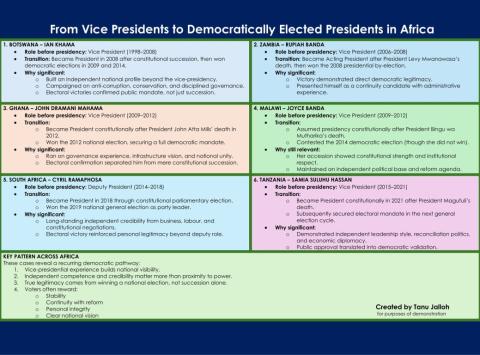
The Vice Presidency becomes a dead end only when it is politically underutilized. When treated instead as a platform for governance mastery, coalition building, and national reassurance, it can evolve into a credible bridge to higher leadership. Thus, the more constructive national question is not whether it is already too late for the present Vice President, but whether Sierra Leone’s political culture is ready to allow experience, continuity, and renewal to coexist in one candidacy.
Finally, We Look At The Possibility Within Structure
Historical caution is valuable. Deterministic pessimism is not. Sierra Leone stands at a moment where institutional memory, governance experience, and generational expectation intersect. In such moments, outcomes are rarely pre-written. They are shaped by strategy, narrative discipline, party cohesion, and national mood.
The Vice Presidency, therefore, is neither curse nor guarantee. It is an opportunity—one whose final meaning will be decided not by precedent alone, but by preparation, performance, and the electorate’s judgment of who is most ready to lead the nation forward.
History may be patient. But possibility, when recognized and acted upon, is always timely.