


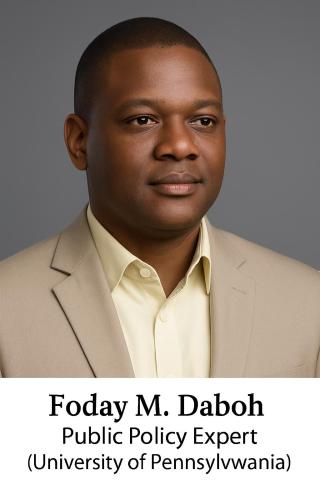
By Foday M. Daboh
There are policy mistakes you can reverse with a memo. And then there are mistakes that, once made, become a country’s reputation.
Sierra Leone’s apparent decision—announced in early January 2026—to wind up the Mineral Wealth Fund Sierra Leone Limited (MWFSL) and “transition” to a new sovereign wealth framework risks becoming the latter: a reputational wound that tells investors, citizens, and future reformers that our biggest national projects can be launched, branded, negotiated, and then abruptly scrapped when politics, pressure, or panic changes the mood. 
And that is why, yes, Sierra Leone is getting it wrong with the supposed changes to the Mineral Wealth Fund model—not because reform is unnecessary, but because the way this reform is being executed threatens to destroy what should have been President Julius Maada Bio’s strongest legacy: building a credible, rules-based national system for turning mineral wealth into long-term prosperity.
The tragedy: the diagnosis is right, but the prescription is reckless
Let’s be clear: the Mineral Wealth Fund, as designed and launched, raised serious governance red flags. The IMF’s Governance and Corruption Diagnostic explicitly warned that a “recently launched Mineral Wealth Fund…may face similar challenges in maintaining transparency and accountability,” citing issues including opaque board appointment processes and possible political influence. 
The same IMF report describes the MWF as a vehicle wholly owned by a state corporation, and flags fiscal-risk concerns—like the corporation being allowed to borrow (subject to approvals), which can create contingent liabilities for the public purse. 
So, yes: governance concerns are real. But here is the difference between a serious reformist state and an unserious one:
• A serious state fixes governance by strengthening rules, transparency, oversight, and professional management.
• An unserious state changes the nameplate, dissolves the vehicle, and announces a “new framework”—often without demonstrating that the old problems have been solved, or that the new structure won’t repeat them.
The government’s announcement frames this as “a change in vehicle, not a change in vision,” and promises a sovereign wealth fund aligned with international best practice like the Santiago Principles.  Fine words—but credibility in natural-resource governance is not built with press releases. It’s built with continuity, clarity, and binding safeguards.
Why winding up the MWF threatens the very legacy Bio could have owned
If President Bio had gotten the MWF model right, it would have been a historic pivot: from “minerals are dug and exported” to “minerals are structured into national capital.” This is how serious countries build futures—through rules that outlive presidents.
But dissolving the MWF now, after establishing it and tying it to flagship national mineral assets, sends three damaging messages:
1) Sierra Leone’s institutions don’t endure—only political seasons do.
You cannot build a sovereign wealth culture if the foundational institution can be wound up at the peak of controversy. That tells technocrats and reformers inside government: “Don’t invest your reputation in institutions—invest in proximity to power.” That is how states rot from within.
2) The state is admitting it built a high-stakes vehicle it could not govern.
The IMF noted the MWF was “not yet operational” at the time of the diagnostic mission, still finalizing structure.  If we are already dissolving a vehicle in its formative stage, the obvious question becomes: Was this project rushed for optics? And if it was rushed once, why should anyone believe the next vehicle won’t be rushed too?
3) The “reset” risks becoming an accountability escape hatch.
Winding up an institution can easily become a way to bury documentation, dilute responsibility, and move the public conversation from “Who approved what?” to “Let’s focus on the future.” Yet the IMF report specifically emphasizes the need for improved transparency and merit-based selection in senior appointments—including for the Mineral Wealth Fund.  Scrapping the vehicle without simultaneously publishing contracts, governance decisions, and decision trails looks less like reform and more like evasion.
The hard truth: “sovereign wealth” is not a magic phrase
Many African governments have learned to say “Sovereign Wealth Fund” the way people say “digital transformation”—as if the phrase itself guarantees modernity.
But sovereign wealth funds only work when they are protected from exactly what Sierra Leone is flirting with now:
• opaque appointments,
• political interference,
• weak parliamentary scrutiny,
• unclear deposit/withdrawal rules,
• and transactional deal-making that trades long-term national upside for short-term announcements.
The IMF’s warnings around opacity and qualifications are not academic. They’re a preview of the political economy that destroys resource institutions: the fund becomes a shadow budget, a patronage instrument, or a debt collateral machine. 
If the government’s answer to those risks is simply to dissolve MWFSL and promise a “more robust” vehicle, then the country is repeating the oldest governance mistake in the book: substituting structure for integrity.
What Bio should do instead if he truly wants a legacy
If the president wants the mineral-wealth agenda to become his enduring legacy—not a cautionary tale—there is a credible path forward. But it requires discipline and discomfort:
Publish, don’t posture.
If MWFSL is being wound up, then publish: the governance documents, board composition criteria, third-party management arrangements (and credentials), major agreements, and the rationale for termination. The IMF already points to opacity problems and the need for transparent selection mechanisms.  Reform begins with sunlight.
Legislate hard constraints that no president can bypass.
A real sovereign wealth framework must include binding rules on:
• deposits (what revenues go in, and when),
• withdrawals (how much, under what conditions),
• investment policy (risk limits, asset allocation principles),
• reporting and audits,
• conflict-of-interest rules,
• and sanctions for breaches.
Create an appointments process that is not controlled by the same political network.
The IMF proposes an independent recommendation mechanism for leadership positions across accountability bodies and explicitly includes the Mineral Wealth Fund in that logic.  That is not “NGO talk.” That is how you prevent elite capture.
Stop confusing “state participation” with “state discretion.”
State participation can be strategic. State discretion is what scares everyone—citizens included. If the MWF model was flawed, fix the governance and keep the principle. Don’t teach the nation that big reforms are temporary experiments.
The verdict: Yes—this could become Bio’s self-inflicted legacy loss
President Bio’s own communications say the MWF is to be wound up, and a new apex fund created in its place.  If that transition is executed without radical transparency, legal clarity, and demonstrable independence, it won’t be remembered as modernization. It will be remembered as the moment Sierra Leone broke trust with itself.
Because the strongest legacy isn’t launching a Mineral Wealth Fund. The strongest legacy is making it credible enough that even your political opponents cannot kill it.
Right now, Sierra Leone is moving in the opposite direction—toward a future where mineral institutions are born in applause and buried in silence. And if that happens, Maada Bio will not be remembered as the president who secured Sierra Leone’s mineral wealth. He will be remembered as the president who came closest to building a generational legacy—then dismantled it when it mattered most.
About the author: Foday M. Daboh is a public-policy analyst and development practitioner with a strong focus on natural-resource governance, public finance, and institutional reform in fragile and post-conflict states. He holds a Bachelor of Arts in Political Science and International Relations from the University of Pennsylvania and a Master of Public Policy, with additional professional training in governance, fiscal transparency, and development finance.