


By Mabinty M. Kamara
“My head was buried in a bowl of gravel when I felt a sudden hard push, followed by a hit. That was all I could remember. I became unconscious only to be discovered later, bleeding profusely,” said Janet, (not her real name). Recounting this difficult memory, she added: “When I regained consciousness, I was taken to town by my elder sister who is late now. An unknown male molester took away my virginity.”
This is the story of Janet. When she was 15, when she had this life-changing encounter at one of the mines in Jaiama Nimikor in the eastern district of Kono some 8 miles away from its headquarter Koidu.
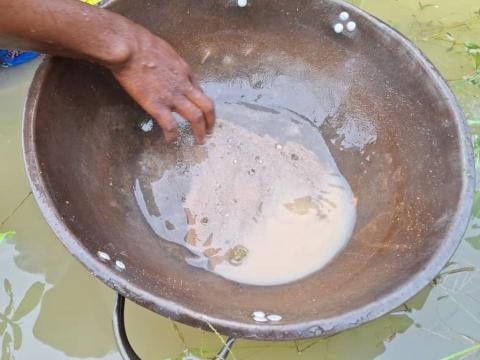
For Janet, now 32 years-old and many other women like her, mining was one of the few means of getting an income following the end of the civil war. After the death of her parents in the bloody civil war, abandoned mines in the diamond rich district of Kono was the easy go to option. She had to grow up fast to fend for herself and her family. She had already dropped out of school because her guardian could barely afford food, in fact making ends meet was a whole struggle in itself.
To achieve this, the 15-year-old would often join adult miners scavenging in already mined-out pits in Jaiama Nimikor, hoping to strike it lucky by discovering diamonds and gold. It was during one of those missions all by herself, that she was raped.
Together with her elder sister, she said they reported the rape to their village head but she couldn’t identify the rapist. Janet’s life changed that day. A month later, she realized she was pregnant. With no one to take responsibility for the pregnancy, life became even more difficult for the teenager who was also now stigmatized by her community.
“A relative had to take the child, away from me to raise her. They have since been living in Koidu town in the same district and I send my little support from what I make from mining,” she said.
The scar is permanent
Janet is not alone in her ordeal. Other female artisanal gold miners that we spoke to in Jaiama Nimikor have also tasted the bitter pill of either rape or sexual harassment, mostly in the mines. For Haja, 48, (also not her real name), she says she was raped and felt so ashamed that she had to flee her community.
“I had to run away from the community to the other village called Guitor, leaving my kids behind in anguish because of the shame. My eldest daughter was not too young at the time and was going to school. So, I was afraid and ashamed to face her.”
The widow with three children said she started gold mining as a means of livelihood after her husband passed away.
She said she would leave the children in the village while she worked in the mines, and on one of those days, she was raped by a man in the village. She reported the rape, but said no one did anything.
“The camp master in the mines dismissed me, saying the rapist must have been my boyfriend,” she said, “He was not, I have never had an intimate relationship with him,” she explained.
Haja later went back to the village because her eldest daughter pleaded with her to return. The man who raped Haja voluntarily left the village. Unlike Janet, Haja knew who attacked her.“Even now I feel very empty inside living in this village. I sometimes cry in my quiet moments.”
There is currently no data on female miners who have experienced sexual violence. Campaigners say this is possibly connected to the culture of silence and shame among survivors, many too fearful to report the attacks.
More danger beyond SGBV
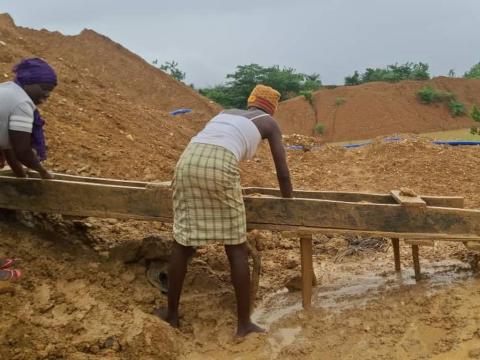
Artisanal mining is a dangerous occupation. It comes with high risk for men and women alike. Women working in the mines are at risk of getting pneumonia due to the long hours they spend on river beds and overflowing mining pits, washing gravel according to health experts.
For Maseray Kamara working at one mine nicknamed “Rocky Graveyard” (Sarahboma) in Massanga Village, Tonkolili district, northern Sierra Leone, she had to learn the hard way how dangerous the mines are when she lost her five-year-old to cold according to the doctor’s diagnosis at the Massanga hospital.
“This was home for me and my children but I had to stop bringing them here after the death of my daughter. So, I now leave my other children in town with neighbours which is also risky,” she said.
Maseray also recounted an instance where a child miner died in a mining accident, after he was buried by debris.
These women also have to constantly be in fear of the law, knowing what they do is illegal. Police raids are frequent in mining areas, given that most the artisanal miners operate without license.
“Last week they were here on a raid. We had to flee to safety, they burnt down my house (makeshift structure) in the mines leaving me only with the clothes I had on when I ran away,” said Isatu Kamara, a gold miner at Massanga. For Isatu and the other miners, these raids mean deprivation, hunger and lack of livelihood.
The advocacy work
A lot of advocacy work has been done over the years in Sierra Leone, to ensure that citizens benefit from the country’s natural resources, especially in mining communities.
The Network Movement for Justice and Development (NMJD), a mining rights and advocacy group, has worked in Sierra Leone for over three decades.
Emmanuel Gbondo, the Program Lead Natural Resource Governance from the organization, said women living in mining communities are the most vulnerable.
“They lose their drinking and domestic water sources as a result of mining activities, farm lands, habitats and other facilities. And in most cases, men who migrate for mining jobs into their localities take advantage of the women, especially the younger ones who are left with the burden of caring for children alone,” Gbondo said.
On the issue of certification, he said the women generally do not have artisanal mining licenses due to lack of money. However, new land reform laws like the National Land Rights Act and the National Land Commission 2024 will now give them new opportunities to own land.
Acknowledging the predicament of female artisanal miners, Esther Kandeh -Executive Director of Women in Mining and Extractives Sierra Leone, a mining and environmental advocacy group for women, said the organization created cooperatives so that the women can support each other financially as well as work in groups to avoid being raped.
“With the cooperatives we have established in six mining communities including Jaiama Nimikoro, women now support each other through village savings and loan scheme. They also go to work in groups. So, it makes it difficult for one strange man to just walk in and try to rape any of them,” she said. However, Kandeh said her organization does not have funding to monitor those networks and expand them into other areas.
For Janet and other women, the cooperative is not only a support group but a lifeline.
“Apart from the soft loan I get from the box (cooperative), I now feel safe to go out mining because we are at least three women in a group, when we decide to go out and mine in any area. I also do small gardening alongside the mining and send the produce and some cash to my daughter who stays in Koidu with my sister,” she said.
An assessment of the Socio-Economic Impact of Artisanal Mining on Women in Sierra Leone by Women in Mining Sierra Leone indicates that the gender distribution in the artisanal mining favors women greatly because of the low income that is provided.
However, recent data from the National Minerals Agency (NMA) indicate that there are only 130 registered artisanal female miners across four districts in Sierra Leone. “95 in Kono, 7 in Bombali, 23 in Kenema and 5 in Bo,” Said Jariatu Bah, Communication Manager at the NMA.
The regulatory framework
The Mines and Minerals Act 2009 created the legal framework for artisanal miners to operate. In addition, there are operational, social and environmental regulations that guide artisanal mining operations. Sierra Leone subscribes to international and regional conventions and standards that impact such operations.
Despite existing legal and regulatory frameworks as well as international conventions and standards, insufficient attention has been given to regulatory oversight of artisanal mining in Sierra Leone.
In the same vein, the 2018 Artisanal Mining Policy for Sierra Leone acknowledges the challenges highlighted, assuring that cultural and traditional practices that restrict or negatively impact women’s involvement in artisanal mining operations should be dismantled.
However, seven years on from the launch of this policy, many women in mining communities still face huge financial and safety risks going out to work each day, risks they are forced to take for the survival of their families.
This investigation was supported by BBC Media Action and funded by Deutsche Gesellschaft für Internationale Zusammenarbeit (GIZ) GmbH on behalf of the German Federal Ministry of Economic Cooperation and Development (BMZ), co-funded by the European Union (EU).
Copyright © 2025, Politico Online